φ-Lattice Trust Engine Runtime Reliability for Enterprise AI
φ-Lattice is a runtime trust layer for enterprise-hosted LLMs. It analyzes the intrinsic mathematical structure of reasoning and turns reliability risk into a trust score, evidence trail, and routing decision before output reaches users or downstream workflows.
Every Other Approach Has a Fatal Dependency
Current AI trust solutions all need something external to the reasoning to validate it. They break exactly when you need them most — on novel queries, creative tasks, and edge cases where no reference exists.
| Approach | How It Works | Why It Fails |
|---|---|---|
| RAG Validators | Compare output against source documents. | ✗ Useless for inference, novel queries, or multi-step reasoning. Only catches retrievable facts — misses logical errors entirely. |
| Heuristic Guardrails | Pattern-match against predefined rules. | ✗ Brittle. Easy to bypass. Requires constant maintenance. Domain-specific — doesn't transfer. |
| LLM-as-Judge | Run a second model to evaluate the first. | ✗ Doubles cost. Same hallucination risk. No mathematical guarantee — one model's opinion about another. |
| Confidence Scores | Use model's own token probabilities. | ✗ Models are confidently wrong. Calibration degrades on out-of-distribution inputs. |
| φ-Lattice | Analyze the intrinsic mathematical structure of reasoning. | ✓ Works on anything — novel queries, creative tasks, multi-step reasoning. No external dependency. Mathematical proof, not statistical opinion. |
A Fundamentally Different Approach to Trust
A physicist can tell if an equation is self-consistent without knowing the answer. φ-Lattice applies the same principle to AI reasoning — acting like a non-invasive brain scanner that analyzes geometric coherence to determine reliability from structure alone.
No Ground Truth Required
Evaluates reasoning quality without comparing against reference documents or curated datasets. Works on novel queries where no "correct answer" exists to check against.
No Heuristic Rules
Uses mathematical invariants — universal properties of coherent reasoning — not brittle pattern-matching that breaks on new domains or adversarial inputs.
No Second LLM
No second-model inference. Minimal runtime overhead. No recursive hallucination risk. Operates on mathematical structure, not natural language generation.
Inline, Not Post-Hoc
Operates within the inference pipeline in real time. Catches failures before they reach users — not after damage is done.
Evidence, Not Opinions
Produces mathematical evidence of why an output was scored as trusted or flagged. Auditable. Reproducible. Defensible to regulators.
Your Models, Your Infrastructure
Works with any open-weight or self-hosted LLM — Llama, Mistral, your fine-tuned models. Full data sovereignty: nothing leaves your infrastructure.
See the Signals in Real-Time
Watch how φ-Lattice detects confidence-masked hallucinations versus verified reasoning.
How It Fits Into Your Stack
φ-Lattice deploys as a lightweight middleware layer between your LLM and your application. No model changes. No retraining. No vendor lock-in.
Your LLM
Llama / Mistral / Your Custom Models — deployed on your infrastructure
- • Query Inference
- • Raw Generation Stream
φ-Lattice Trust Engine
Inline Middleware Verification
- ✓ Geometric Analysis
- ✓ Invariant Validation
- ✓ Evidence Generation
Your Application
Safe downstream business process
- • Trust Score (0-1)
- • Evidence Trail
- • Compliance Mapping
- • Flag / Pass Signal
Integration: REST API or SDK. Drop-in middleware for LangChain, LlamaIndex, and custom pipelines. Typically integrated in <1 day for proof-of-concept.
Built for Regulated Enterprise Workflows
φ-Lattice unlocks AI deployment in environments where "usually correct" isn't good enough.
Healthcare
Clinical decision support with mathematically auditable trust scores. Every AI recommendation carries provable evidence of reasoning quality. HIPAA-compliant audit trails generated automatically.
Financial Services
Advisory compliance with real-time reasoning validation. Detect when models make unsupported claims about products, risks, or projections. Designed to support SOX/FINRA audit evidence workflows.
Legal & Contract Analysis
Validate reasoning chains in contract review, clause interpretation, and legal research. Flag logical inconsistencies before they reach attorneys. Defensible audit trail for malpractice protection.
The Science Behind the Score
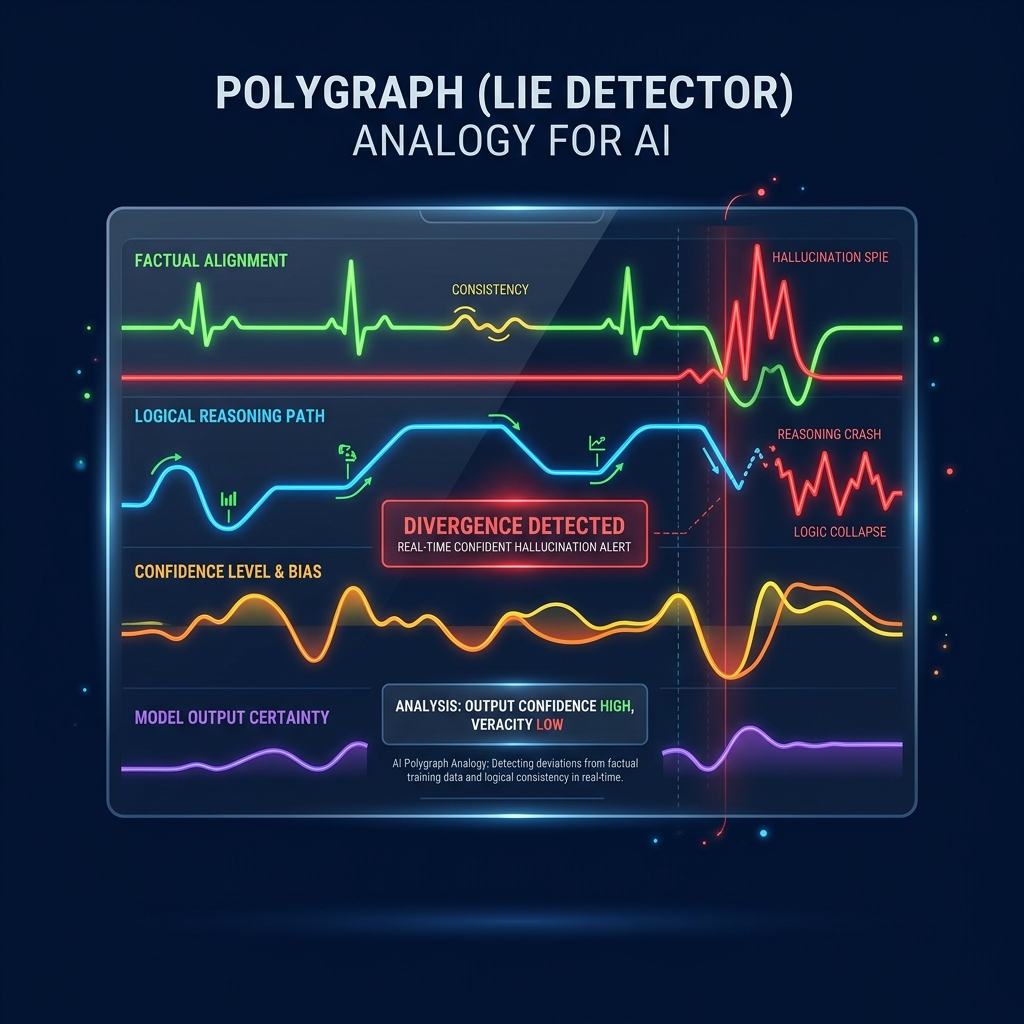
Operating like a polygraph or a non-invasive brain scanner for LLMs, φ-Lattice reads reasoning telemetry at runtime without altering model weights. Coherent reasoning has measurable geometric properties — and hallucinations violate them.
Geometric Coherence Analysis
Rather than checking what an AI said, φ-Lattice analyzes how it reasoned. Coherent reasoning produces specific mathematical signatures — hallucinations and errors produce measurably different structures.
Mathematical Invariants
Trust scoring uses universal mathematical properties that hold regardless of domain, language, or model architecture. This is why φ-Lattice transfers across use cases without retraining.
Intrinsic, Not Extrinsic
The analysis is intrinsic to the reasoning structure — it doesn't need external references, rules, or other models. Think of it like checking if a bridge's geometry is structurally sound without needing to see the original blueprints.
Like a Polygraph for AI Reasoning
A polygraph tracks stress and biometric indicators to identify when a subject is fabricating claims. φ-Lattice applies the same deterministic analysis to AI reasoning geometry — acting like a non-invasive runtime monitor.
- ✓
Non-Invasive Runtime Reading
Analyzes reasoning structure at runtime without altering model behavior or injecting prompt noise.
- ✓
Detecting Coherence Spikes
Coherent reasoning follows stable, mathematically consistent geometric paths. Fabrications and errors create sudden geometric "spikes" and logic collapses.
- ✓
Biometric-Style AI Signals
Tracks multiple mathematical parameters representing reasoning stability and coherence.
- ✓
Real-Time Remediation Routing
Outputs a clean trust score (0-1) to trigger automated downstream decisions: Pass, Noisy, Suspicious, or Needs Review.
What We're Building
φ-Lattice ships as two core products — a real-time trust gateway and an evidence API — purpose-built for teams deploying LLMs in regulated environments.
Trust Firewall In Development
Inline gateway that scores every LLM output before it reaches users. Blocks hallucinations, flags reasoning failures, enforces compliance boundaries.
Evidence API In Development
Generates auditable mathematical evidence for every trust decision. Maps to regulatory frameworks (HIPAA, SOX, FINRA). Immutable audit trail for compliance teams.
Reliability Dashboard In Development
Real-time visualization of trust topology across your AI fleet. Executive-level compliance KPIs. Engineering-level diagnostic depth.
Get Early Access
φ-Lattice is currently in private beta with select enterprise partners in healthcare and financial services. We're accepting applications for early access from organizations deploying LLMs in regulated workflows.
Program Partnerships & Protection
For investors and partners: technical deep-dive available under NDA. Contact us →