φ-LATTICE · INFERENCE ASSURANCE
Assurance is not a detector
What it actually takes to trust a model's decision at the moment it is made.

Something genuinely useful is happening in enterprise AI. For the past two years the industry has guarded the perimeter — filtering what goes into the model, scoring what comes out, logging the exchange for later review. Now attention is moving to the one place that has remained hardest to observe: inside the model, while the inference is actually happening. That shift is overdue and correct. A finished answer is a lossy summary of the computation that produced it, and the computation is where the decision actually gets made.
But look closely at what is being built under that banner, and most of it has the same shape. Watch the internal signals. Spot an anomaly. Turn it into a score. Attach that score to the output, perhaps with a note about what looked wrong, and move on.
This is a real advance over reading the finished text. It is not assurance.
The gap between the two is the difference between an observation and a claim. A score is an observation: something in this generation looked unusual relative to some baseline. Assurance is a claim about a particular decision — that it was produced the way you believe it was produced, that it complied with the policies you have set, and that you can demonstrate both to someone who asks you about it eleven months from now. Observations do not become claims by being numeric. They become claims when they are measured on a stable scale, interpreted against the obligations of that specific use case, and preserved in a form that survives being questioned.
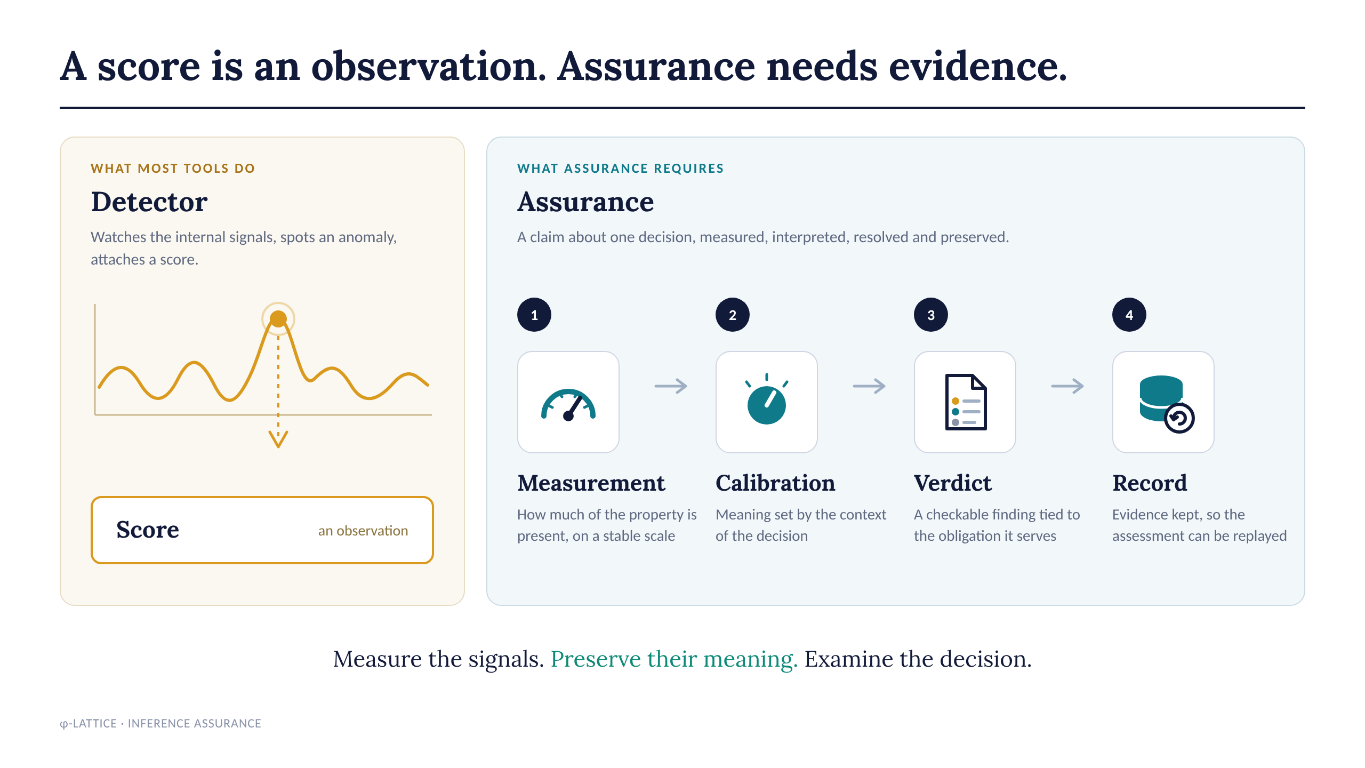
That takes four things, and the industry conversation usually stops after the first.
It begins with measurement rather than detection, which sounds like a semantic distinction and is not. A detector asks a binary question — does this look wrong — and answers it using a threshold. Measurement asks a quantitative one: how much of this property is present, on a scale whose meaning is preserved, so that a reading taken in January can still be understood in June. The difference is that a detector hands you its builder’s judgment about what counts as wrong, while a measurement hands you the raw quantity and lets you decide. In a regulated institution, that decision belongs to the institution — not the vendor.
Measurement alone, though, is a number without a meaning until it has a reference point, and the reference point comes from the context the decision was made in. What counts as an acceptable level of uncertainty in a document summary is not what counts as acceptable in a credit decision. What counts as a suspicious pattern when a model reads contracts is not what counts as suspicious when it reads clinical notes. Calibration is how a measurement acquires meaning, and a calibration valid for contract review is not automatically valid for clinical notes.
A calibrated measurement then has to resolve into a verdict, and the verdict has to be checkable. Not a vague confidence level, but an explicit finding about the decision — no issues detected, cause for caution, or an unreliable result — tied explicitly to the obligation it is serving, so that a reviewer can ask whether the right standard was applied and get an answer. The verdict states what was found. The institution’s policy determines what happens next.
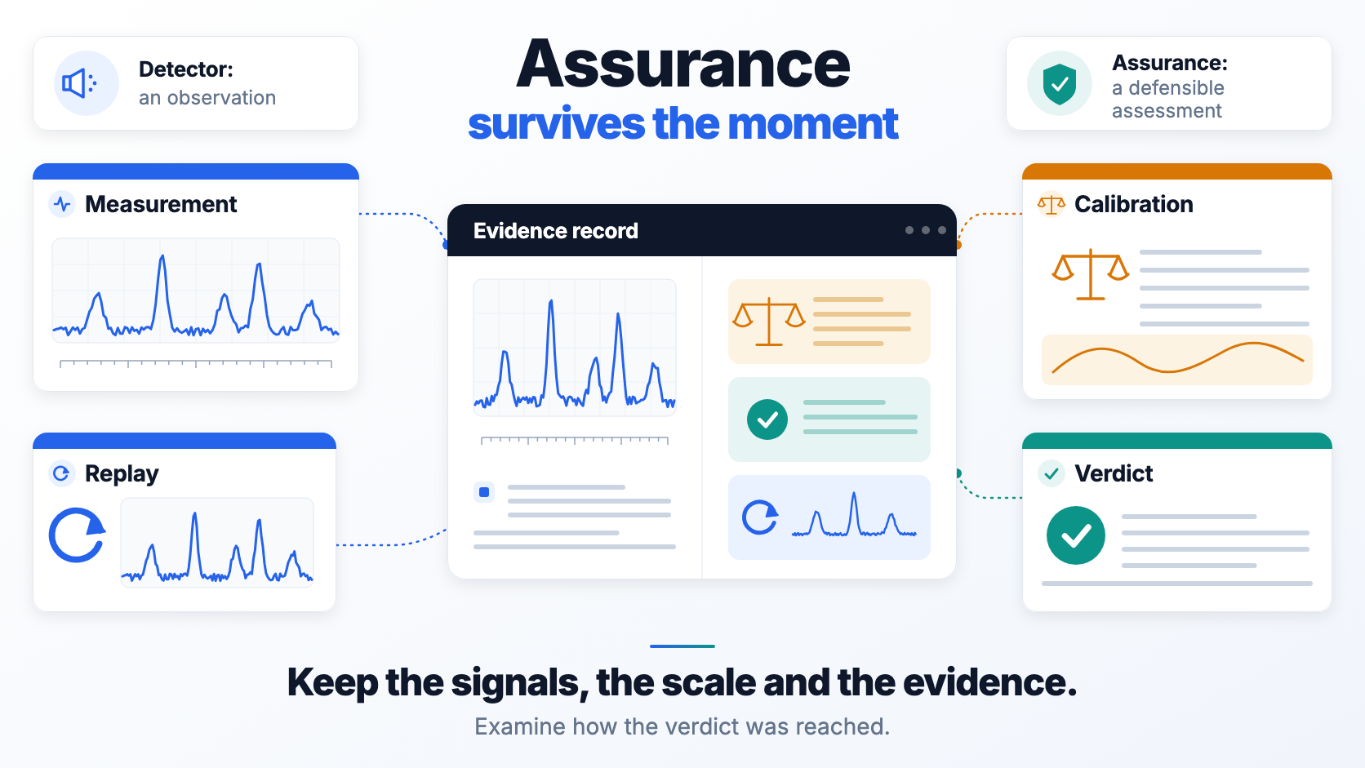
All of this is worth nothing to a regulated institution if it exists only for the duration of the request. The reckoning, when it comes, is rarely a question of average accuracy. It is a question about one decision — made months ago, by a model that has since been updated, and now being challenged by a customer or an examiner. Answering that question requires the signals, active configuration, thresholds, and verdict to have been captured as the inference happened, along with everything needed to replay the assessment. Replay cannot recover evidence that was never preserved. With that evidence in hand, the institution can examine how the verdict was actually reached — not simply read a record of what was produced.
Measure. Calibrate. Verify. Record.
Most of what is being built under the banner of inference-time safety does the first half of the first one. That is a real start, and it is not the same thing as assurance. Assurance is not a detector. It is a measurement discipline that turns observations into defensible verdicts and preserves the evidence needed to replay them. The distance between those two ideas is the whole problem.
φ-Lattice measures a model’s computation as it generates, calibrates the assessment to the workflow it serves, and preserves the evidence so the decision can be examined long after the inference is gone. Get in touch.