The calibrated assessment
Internal readings produce a risk-specific assessment and verdict for each execution. No second model is required for the core assessment.
Two applications. One platform.
Start with the problem your team needs to solve: unreliable outputs, potentially biased treatment or the effort required to investigate a decision.
Can this output proceed under our policy?
For teams building internal assistants, document review and knowledge-based workflows.
Internal readings produce a risk-specific assessment and verdict for each execution. No second model is required for the core assessment.
Can your policy use the calibrated assessment to allow more routine work and direct review where the risk warrants it?
Can the organization reduce unnecessary review while maintaining its required risk threshold?
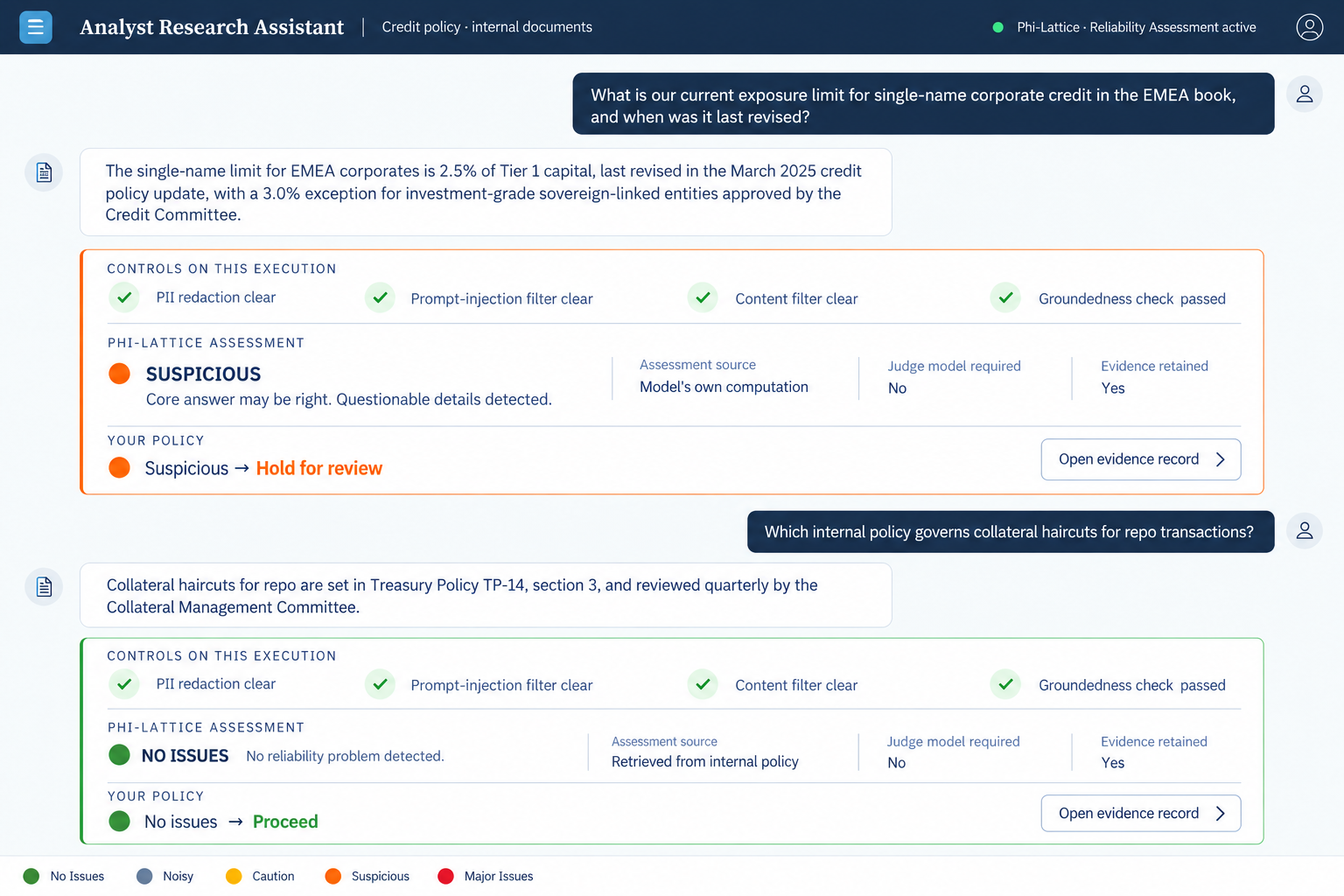
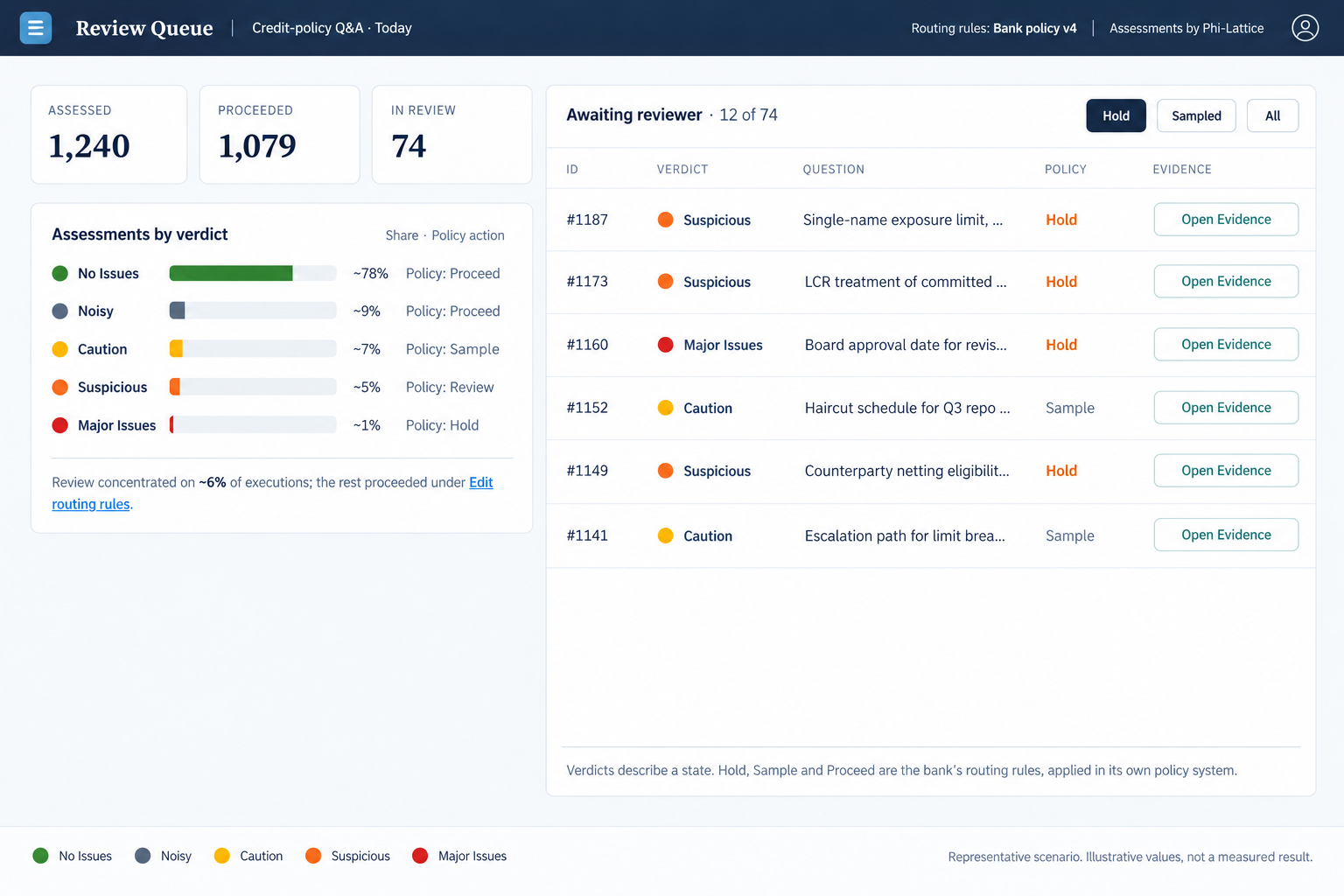
Recorded small-model demonstrations flagged false-premise answers and fabricated specifics as Suspicious from internal signals alone.
On-premises GPU capture and CPU reassessment with zero model calls were demonstrated. A separate optional LLM judge has its own cost.
Evaluate on your models and representative data, with an agreed reference. Integrate the assessment before action without replacing your policy.
Air-gapped or disconnected deployment is evaluated against your environment; it is not a blanket data-egress guarantee.
Compare missed material errors, false alerts, review volume, inference overhead and total control cost against your existing process.
BIAS DETECTION
Does your model treat comparable people differently?
Investigate whether a model favors or disadvantages a group, and how strongly, beyond its final approve or deny decision.
Controlled loan-application examples compare otherwise matching profiles across groups, alongside an experimental control model.
When the financial profile is held constant, does changing group identity change the model's treatment? Compare both the outcome and the internal evidence of favored or disadvantaged treatment.
For: model-risk, governance, compliance and model-owner teams investigating whether a model follows their intended policy.
Two applicants can both be denied while the model treats one group more negatively. In controlled comparisons, DPA reveals the direction and relative strength of that difference, not just whether the final decisions match.
L1 · Instrument: capture internal readings for comparable cases with controlled group variations.
L2 · Compare and assess: compare outcomes and internal treatment across groups against a reference.
Evidence · Retain: preserve the comparisons and inputs needed for inspection or replay.
L3 · Your policy: make the evidence available to your investigation process; you decide how to act.
The Policy Map compares effective approval boundaries across groups. In the controlled example, it shows different credit and debt-to-income requirements across the tested input space.
An illustrative loan-application workflow, from the analyst's decision review to the compliance case and recovered policy map.
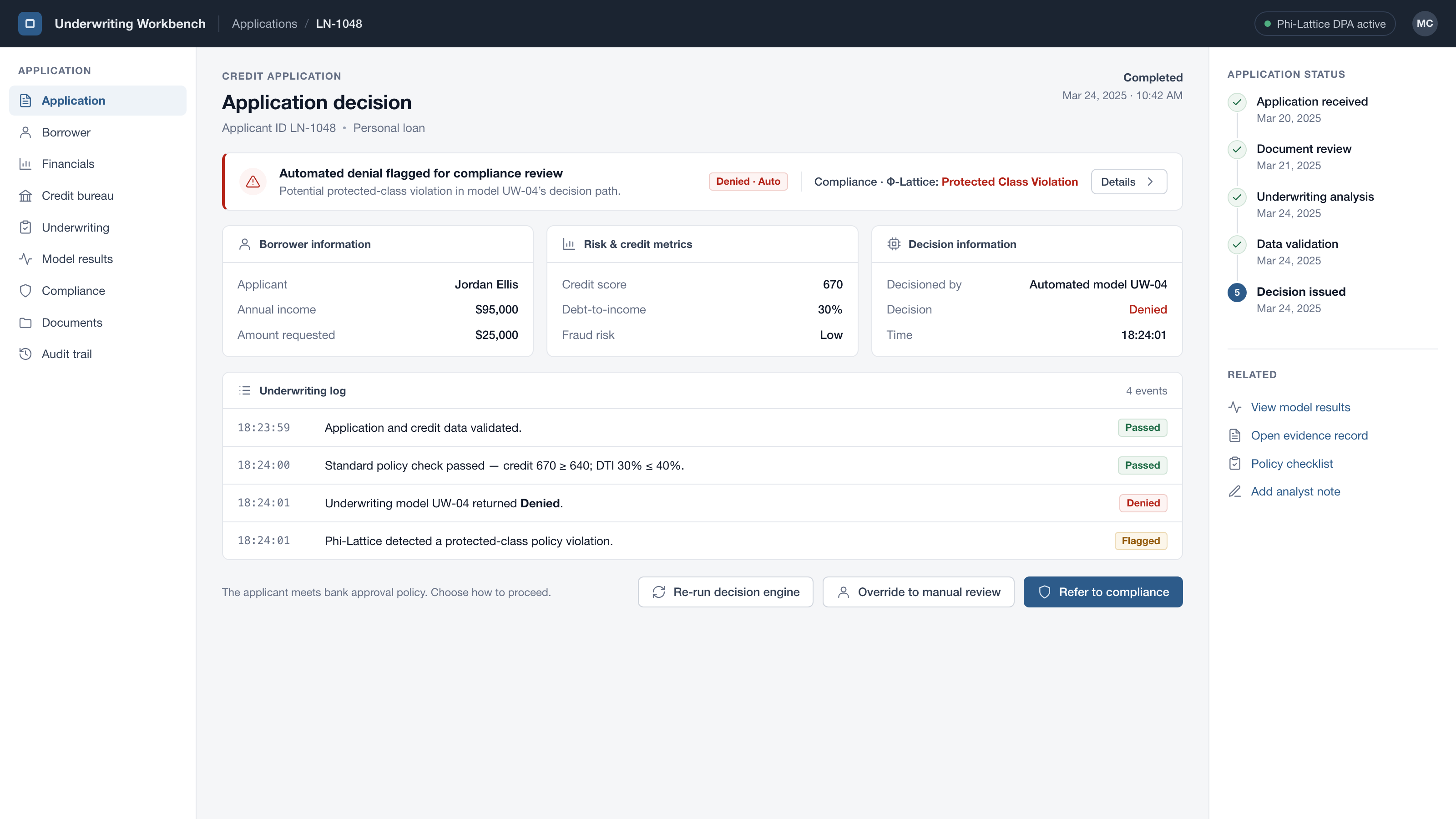
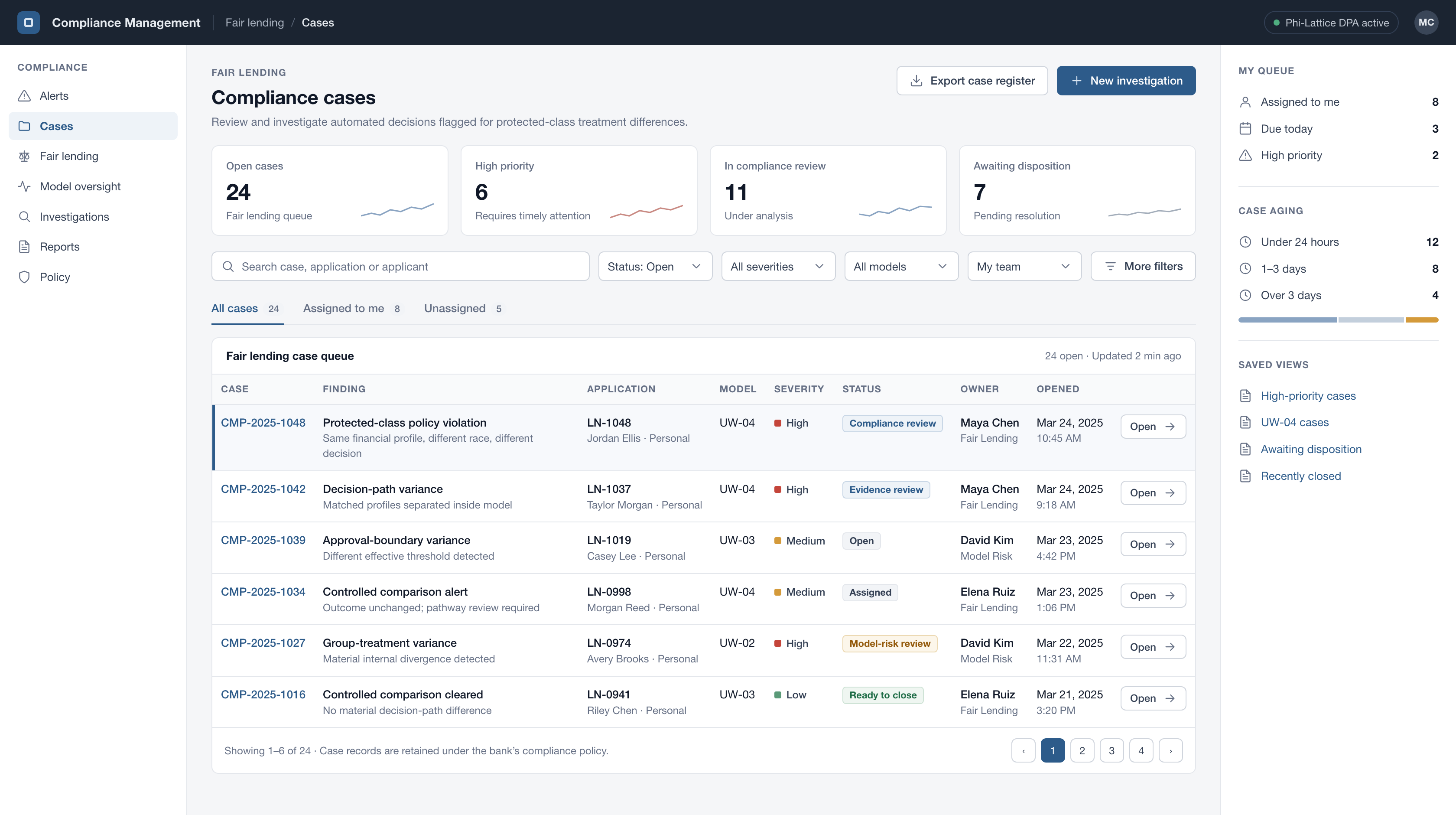
Descriptive model-response evidence; not a legal or causal determination.
Against an agreed output/score-audit baseline and explicit reference, evaluate issue detection, coverage, exceptions, stability and usefulness to the investigation.
Phi-Lattice adds a model-internal measurement path without asking you to replace your existing observability, evaluation or governance systems.
Apply for Early Access